
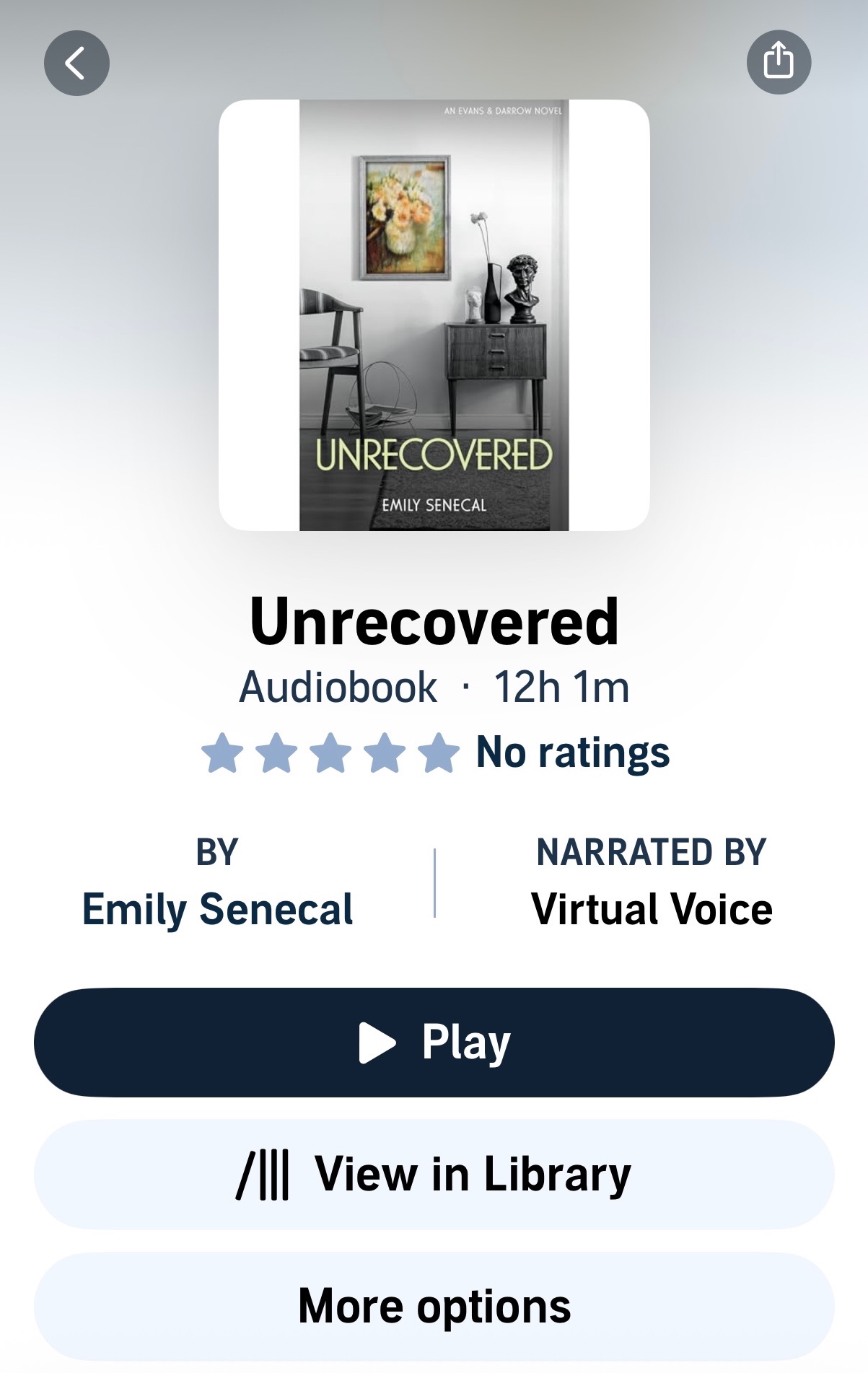
Kindle Direct Publishing recently launched a beta virtual voice audiobook format. As soon as I learned that this was an option, I didn’t hesitate to create my first audiobook, which recently went live on Audible.
For any authors considering this format, or any readers curious about virtual voice narration of audiobooks, I would say — at least at this point in my experience — that in spite of some shortcomings, it’s an accessible and effective solution.
Virtual voice narrators have obvious limitations, especially when it comes to dialogue in different accents or dialects. KDP gives you a fairly wide selection of male and female voices in different accents to choose from, and you can set different voices for individual chapters, but that’s where the selection options end. Overall, I found that the voices reacted extremely well to dialogue and narrative, often using the right context, cadence and timing automatically. The voice options varied in both tone and expressiveness.
Once you choose a voice, the Virtual Voice Studio allows you to preview the narration, and to change pronunciations on words and phrases, add pauses and adjust the voice speed. You can also try out other voice options to hear how they sound reading your work. I didn’t use the speed function, and only added a few pauses. However, I found the pronunciation tool to be crucial and constructive asset, allowing me to smooth out dialogue, modify names, fix occasional mispronounced heteronyms (wound, lead), make adjustments to inflections, and ultimately have a lot of creative control in a virtual environment. I could change every “would have” to “would’ve” in one step, and then revert a single occurrence back to “would have” if I wanted to emphasize the verb phrase differently. I appreciated the fact that it autosaved every change, so I never worried about losing my edits.
Because I felt it best fit my novel, I opted for an American English female voice, who I named Evelyn. Evelyn and I occasionally had intense disagreements about how a certain word or sentence should be said, and goodness, could she be stubborn! I eventually had to surrender to her very East-Coast pronunciation of Nevada (she firmly preferred “Nevahhda”). Evelyn didn’t much like saying “latte” correctly, either, but we finally came to happy consensus with “lawteh.”
I found the pronunciation tool to be crucial and constructive asset, allowing me to … have a lot of creative control in a virtual environment.
I became an expert at finding odd combinations of letters, hyphens and punctuation to use in order to get the right cadence, and spent probably 40 or 50 hours on one 12-hour audiobook. That being said, now that I know what I’m doing, my other books should take much less time, probably only needing one round of voice editing. Having gone through it once, I do plan to publish all of my titles as virtual voice audiobooks.
I recognize that people will have differing, often strong opinions about applying artificial intelligence to creative works. AI is everywhere; we’re warned of the dangers and drawbacks as we enjoy the benefits, constantly learning about new tools and advancements and controversies.
We’re in an interesting moment in history, when enough of us remember life before even the Internet to make some of this feel very surreal. A computer voice reading books in place of a person? (Before it becomes evil and tries to take down humanity in some nefarious and violent way.) It’s a plotline right out of fiction.
I agree that we should be wary of the risks, but I’m a big proponent of AI when used responsibly, which I think most of us do, most of the time. I appreciate that KDP is increasingly transparent and vigilant about the use of AI in publishing, even as they struggle to regulate it. Virtual voice audiobooks list the narrator as Virtual Voice, and announce the virtual narrator in both the opening and end credits. No one is being tricked, even as I worked hard to provide an authentic reading of my work.
A few people have made squinchy faces as I told them about this. While I understand where their distaste or distrust may be coming from, I can only argue that an audiobook version of my book simply wouldn’t be possible without virtual narration. My current independent publishing budget won’t cover the cost of a professional narrator, and I don’t have the connections, equipment or broadcast experience to make my own recording. If my books had higher sales numbers, I might have bid for royalty-sharing with voice actors, but that wasn’t an option either.
Would it be better for me not to use this tool and not offer audiobooks, just because it’s an application of AI?
A few people have made squinchy faces as I told them about this. While I understand where their distaste or distrust may be coming from, I can only argue that an audiobook version of my book simply wouldn’t be possible without virtual narration.
Visually-impaired readers, anyone who prefers listening to books to reading them, and any reader who wants to continue a book in different formats (from Kindle to car or treadmill, for instance), would be left with the basic screen reader, without any modifications. While technically accessible, that doesn’t compare with the quality of even a virtually-narrated audiobook that has been zealously edited by the author.
The editing control the studio provides is fundamental to my comfort level with this new format, and why I believe customers may not be disappointed if they try it out. I would urge authors to put the time into making sure that the narration doesn’t contain any glaring errors, mispronunciations or odd phrasing, and that you choose a voice that best represents your work.
In terms of distribution, since my title is enrolled in KDP Select, so is the audiobook, allowing Audible members to listen for free. It can also be purchased as an add-on to the other formats or purchased on its own via Audible or Amazon. Whenever I update the eBook format, the audiobook is automatically updated with the new version, retaining all of my existing studio edits. These features make the process very easy and straightforward, taking any guesswork out of publication.
So will KDP virtual voice audiobooks offer a viable product to readers who want to listen to books, and an affordable solution to authors who want to publish them? Time will tell, but I’m hopeful that it will.
Now that my first audiobook is available, I’m interested to see if it reaches different audiences, and how readers react to Evelyn. She can’t offer the same quality of narration as a human actor, but she was my virtual collaborator on this project, and I’m proud of what we were able to create together.
Please, just don’t ask her to say Nevada.
